Best Woodworking Clamps of 2026: F-Clamps, Bar Clamps, and More
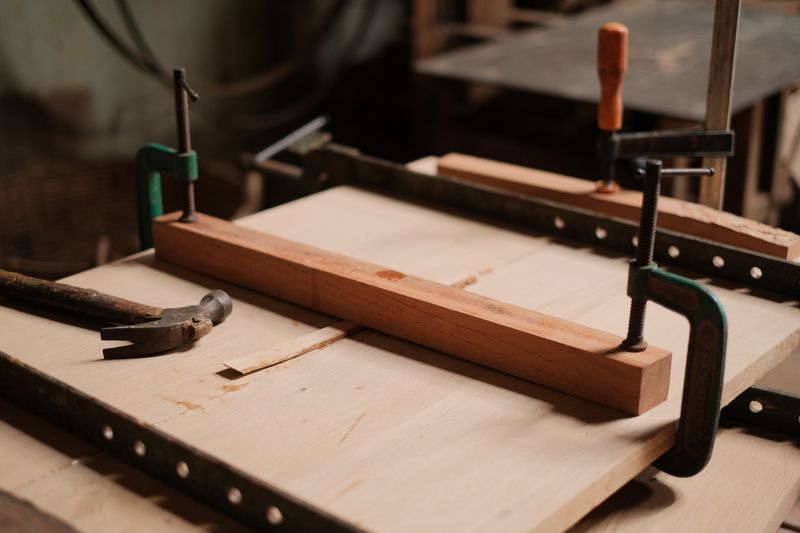
Ask any experienced woodworker what tool they wish they’d bought more of early on, and the answer is almost always clamps. You can never have enough. Whether you’re gluing up a panel, assembling a cabinet, or holding a workpiece for joinery, clamps are the third hand that makes precision work possible. The right clamp — in the right size, in the right quantity — is often the difference between a glue-up that comes together perfectly and one that springs open when you’re not looking.
This guide covers the main types of clamps woodworkers use, what to look for when buying, and the best options at every price point in 2026.
Types of Woodworking Clamps
Understanding the different clamp types before you buy will save you money and frustration. Each type has a specific strength, and most workshops eventually use all of them.
F-Clamps (Bar Clamps with a Fixed Jaw)
The F-clamp is the Swiss Army knife of the workshop. The fixed upper jaw and sliding lower jaw — connected by a flat bar — let you clamp workpieces of varying thickness quickly. Most F-clamps have a swivel pad on the screw end that prevents marring.
They’re the right choice for:
- Holding parts together during assembly
- Edge gluing where the parts need to come together laterally
- Securing jigs and fixtures to a bench
- General-purpose one-handed clamping
Reach (the depth of the throat) matters enormously. A 3-inch throat only reaches 3 inches from the edge of the board. For cabinet sides, panels, and furniture parts, 4-inch and 6-inch throat clamps are more versatile.
Parallel Clamps (Cabinet Clamps)
Parallel clamps — sometimes called cabinet clamps — have two flat, parallel jaws that remain perpendicular to the bar throughout their travel. This matters a great deal for panel glue-ups and cabinet assembly: standard F-clamps can flex under pressure and apply uneven clamping pressure that causes glued panels to bow.
Parallel clamps are more expensive than F-clamps but they’re the right tool for any glue-up that needs to come out flat. For serious woodworking, a set of 24-inch or 36-inch parallel clamps is worth every penny.
Pipe Clamps
Pipe clamps use standard 3/4-inch black iron pipe (sold separately) as the bar, with a fixed head and a sliding tail stop. Because you choose the pipe length, pipe clamps are infinitely adjustable to the task — a 6-foot pipe for a wide dining table top, a 3-foot pipe for a small cabinet. You buy the fixtures once and cut or purchase new pipes as your projects grow.
Pipe clamps apply substantial clamping force and are excellent for large face-glue panels and wide glue-ups. The downside is that the round pipe can bow slightly under high pressure, allowing the workpiece to creep upward. A piece of caul clamped perpendicular across the joint prevents this.
Spring Clamps
Spring clamps (sometimes called C-clamps or pinch clamps) work like a large clothespin. They apply light, consistent pressure without any adjustment — you open the jaws, position the clamp, and release. They’re ideal for holding parts in place while glue tacks up, clamping thin stock, or any application where moderate pressure over a short hold time is enough.
Spring clamps are inexpensive and you should own a dozen or more.
Corner Clamps and Specialty Clamps
Corner clamps hold two pieces at a right angle during assembly — invaluable for building square picture frames, drawer boxes, and cabinet face frames. A good corner clamp is worth far more than trying to improvise a 90° alignment with standard clamps.
Band clamps wrap a strap of nylon webbing around irregular shapes — ideal for clamping chair legs, coopered panels, and round or polygonal assemblies where standard jaws can’t get purchase.
Key Features to Evaluate
Clamping Force: F-clamps and parallel clamps are rated by how much pressure they can apply in pounds. For gluing solid wood edges together, you need 150–200 PSI across the joint — a modest 6-inch parallel clamp delivers far more than this. For veneering, you need much less. Match the clamp to the task.
Jaw Depth (Throat Depth): This determines how far from the edge of a workpiece the clamp can reach. A 3-inch throat clamp won’t secure a joint in the center of a 10-inch-wide panel. Check throat depth before buying, especially for longer bar clamps.
Bar Stiffness: Under high pressure, clamp bars can flex and apply uneven force. Parallel clamps are designed with wider, stiffer bars that resist this. Cheaper bar clamps with thin bars will bow noticeably under serious clamping pressure.
Pad Material: Hard metal pads dent soft wood under pressure. Quality clamps include plastic or rubber pads, or swivel pads, to distribute force and prevent marring. For fine furniture work, add cauls (scrap wood pieces) between the clamp pads and your workpiece regardless of pad material.
Ease of Adjustment: The quickest clamps to use are ones you can position with one hand. A sliding lower jaw with a positive lock and a quick-release button is much faster to use than one that requires two-hand tightening.
Top Woodworking Clamp Recommendations
Best Budget F-Clamp: Irwin Quick-Grip One-Handed Bar Clamps
The Irwin Quick-Grip is the clamp that built the modern workshop. The pistol-grip trigger mechanism lets you open and close the clamp with one hand, position it exactly where you want it, and pump the trigger to apply clamping force. The soft pads protect workpieces from jaw marks without needing cauls for general assembly work.
Irwin Quick-Grips are available in 4-inch, 6-inch, 12-inch, 18-inch, 24-inch, and 36-inch bar lengths. Start with six 12-inch clamps and four 24-inch clamps for a functional starter set. They can also be reversed to use as spreaders — a useful feature for fitting joints under tension.
At around $10–$18 per clamp depending on size, they’re the most cost-effective way to build a functional clamping inventory.
Search Irwin Quick-Grip clamps
Best Parallel Clamps: Bessey K-Body REVO Parallel Clamps
If you only buy one premium clamp type, make it parallel clamps — and the Bessey K-Body REVO is the gold standard. The two parallel aluminum jaws maintain their alignment under full clamping force, distributing pressure evenly across the full width of a glue joint. The spindle applies up to 1,700 pounds of clamping force — more than enough for any solid-wood edge glue-up.
The wide, flat jaws also let you stack multiple clamps vertically on a panel without them falling over, which makes setting up a 10-clamp face glue-up dramatically less frustrating.
Bessey K-Body REVOs are available in 24-inch, 31-inch, 40-inch, and 50-inch lengths. A starting set of four 24-inch parallel clamps handles most furniture projects. The 31-inch length is the most versatile for cabinet work.
At $45–$75 per clamp, they’re an investment — but once you use them for a panel glue-up, the difference from F-clamps is immediately obvious. Many woodworkers buy four at a time as budget allows.
Search Bessey K-Body parallel clamps
Best Pipe Clamp Fixtures: Jorgensen Steel Bar Pipe Clamp Fixtures
Jorgensen pipe clamp fixtures are the most durable option for heavy-duty glue-ups. The fixtures accept standard 3/4-inch black iron pipe and the heavy steel construction resists the flex that plagues cheaper fixtures under serious clamping loads.
Buy the fixtures and then source pipe from a local hardware store or plumbing supply cut to the lengths you need. Common useful lengths: 3 feet, 4 feet, and 6 feet. The ability to extend a pipe clamp to any length is what makes them unbeatable for large panel work.
For a starting workshop, a set of four to six Jorgensen fixtures with 4-foot pipes handles most glue-up scenarios. Add 6-foot pipes when you start building dining tables and wide panels.
Search Jorgensen pipe clamp fixtures
Best Spring Clamps: Irwin Tools 4-Inch Spring Clamps (12-Pack)
For light-duty holding, edge banding, and applying pressure while glue tacks, spring clamps from Irwin are the right buy. The 4-inch size handles most workshop tasks. The vinyl-coated tips protect finished surfaces, and the spring tension is strong enough to hold lightweight trim but gentle enough not to leave marks on soft wood.
Buying a 12-pack is the right move — you’ll use all of them, often simultaneously. At around $25–$35 for a 12-pack, they cost less per clamp than almost any other type.
Search Irwin 4-inch spring clamps
Best Corner Clamps: Woodpeckers Corner Clamp Set
For joining parts at 90°, Woodpeckers corner clamps hold two pieces in a precise right angle while you fasten or glue them. The aluminum body is machined to a true 90°, which is more reliable than inexpensive stamped-steel alternatives that can drift out of square.
These are the right tool for building drawer boxes, face frames, and picture frames. A set of two handles most tasks; four lets you clamp all corners of a face frame simultaneously.
Search corner clamps for woodworking
Best Budget Parallel Clamp Alternative: Rockler Clamp-It Assembly Squares
If Bessey parallel clamps aren’t in the budget yet, the Rockler Clamp-It Assembly Square is a clever alternative for cabinet and face-frame assembly. Four plastic squares register the corners of an assembly at 90° while you drive screws or apply clamps. They’re not a substitute for parallel clamps on a glue-up, but for pocket-hole joinery and assembly work, they keep parts square during fastening.
At around $15–$25 per set, they’re an affordable complement to basic F-clamps.
Search Rockler Clamp-It Assembly Squares
How Many Clamps Do You Need?
The honest answer is: more than you think. A face-glue panel that is 36 inches wide and 48 inches long needs clamps every 6–8 inches along its length — that’s six to eight clamps on the bottom and six to eight on top to counteract bow, or twelve to sixteen total for one glue-up.
A practical starting inventory for a home workshop:
- 6 × Irwin Quick-Grip 12-inch — everyday assembly and jig work
- 4 × Irwin Quick-Grip 24-inch — wider assemblies, cabinet faces
- 4 × Bessey K-Body REVO 24-inch — panel glue-ups
- 4 × Jorgensen pipe clamp fixtures with 4-foot pipe — large face glue-ups
- 12 × Spring clamps 4-inch — light holding, trim, edge banding
- 2 × Corner clamps — boxes and frames
This set handles the majority of furniture and cabinet projects without improvising. As your projects grow — toward wider tables, more cabinets, or production-style work — the limiting factor will always be clamp count.
Clamping Tips
Always use cauls. A caul is a straight scrap of wood placed between the clamp pad and your workpiece. It distributes clamping force across a wider area, protects the surface, and helps keep panels flat during glue-up. Wax or plastic-wrap the caul so glue squeeze-out doesn’t bond it to your panel.
Check for square before the glue sets. Measure diagonals immediately after applying clamps. If the measurements aren’t equal, the assembly isn’t square. Apply a diagonal clamp from the longer corner to the shorter one and check again. You have a working window of 10–20 minutes with most PVA glues.
Don’t overtighten. Enough clamping pressure closes the joint and produces a thin, continuous bead of glue squeeze-out. Clamping so hard that all the glue is forced out of the joint actually weakens it — you want a glue-starved joint, not a glue-free joint. Moderate pressure with well-fitting parts outperforms massive force with poor-fitting ones.
Clamp across, not along. For edge-glued panels, clamp perpendicular to the joint line. Some woodworkers also add caul clamps running lengthwise to keep the panel flat. The flat-panel result is worth the extra setup time.
Related Articles
For more on woodworking assembly, the pocket hole joinery guide covers the Kreg Jig system and when pocket screws are the right fastener choice. If you’re building furniture that needs to go together tight and true, the mortise and tenon joint guide covers the strongest traditional joint in woodworking. And for a full picture of what tools belong in a complete woodworking shop, the essential carpentry hand tools guide covers the baseline hand-tool kit every woodworker should have.

The Carpenter's Guide Editorial Team
Independent trade-focused editorial team