Jointer vs. planer: Which tool should you buy first?
Quick answer
A jointer creates one flat face and one straight, square edge; a thickness planer makes the opposite face parallel and brings a board to consistent thickness. If you can buy only one, a thickness planer is usually the more versatile first machine when you have a safe alternative for establishing the first flat face. Buy both when you regularly mill rough lumber, or buy neither when surfaced stock and lumberyard milling meet your needs.
Common questions
- What is the main difference between a jointer and a planer?
- A jointer creates a flat reference face and can straighten an adjacent edge. A thickness planer references the face on its bed, cuts the opposite face parallel to it, and brings the board to a consistent thickness.
- Should a beginner buy a jointer or planer first?
- A thickness planer is usually the more versatile first purchase if the beginner buys already-flat stock or has a safe, proven way to establish the first reference face. A jointer is the better first purchase when correcting bowed, cupped, or twisted rough stock is the immediate job, but a planer is still needed for repeatable thickness.
- Do you need both a jointer and a planer?
- You need both machines for the fastest conventional workflow from rough boards to flat, square, consistently thick stock. You may need only one—or neither—if you buy S3S or S4S lumber, pay a mill to surface boards, or use hand tools and compatible jigs for the missing operations.
Source note: This comparison was checked on October 28, 2026, against current search results, the official Grizzly G0813/G0814/G0814X jointer manual, the official DeWalt DW735 thickness-planer manual, and OSHA and CCOHS woodworking-machine safety guidance. It is a decision aid, not a hands-on product test.
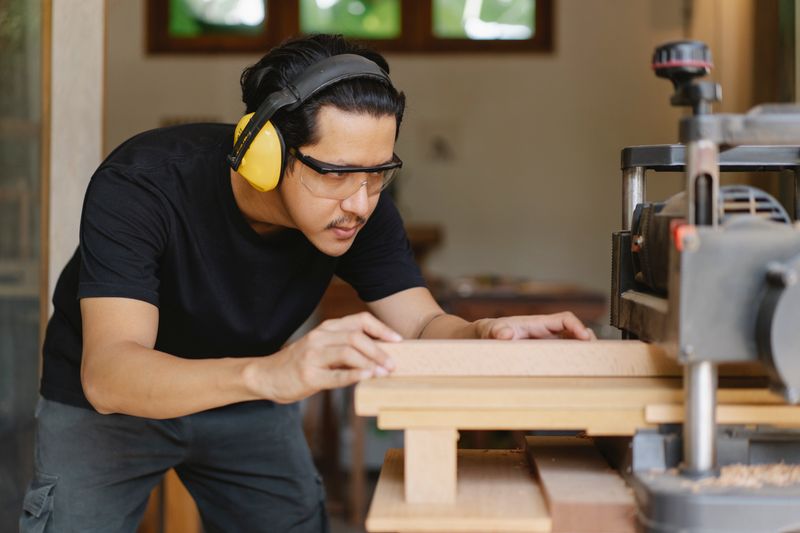
A jointer and thickness planer solve different stages of the same lumber-milling problem. The jointer establishes the first trustworthy surfaces. The planer uses one of those surfaces to make the other face parallel and set the board’s thickness.
For most small shops buying one machine, the thickness planer is the more versatile first purchase—but only with a suitable flat face or a safe way to create one. A jointer comes first when rough, bowed, cupped, or twisted stock is the problem.
Jointer vs. planer at a glance
| Question | Jointer | Thickness planer |
|---|---|---|
| Primary job | Creates one flat face; straightens and squares one edge to that face | Makes the opposite face parallel; reduces the board to consistent thickness |
| Corrects cup, bow, or twist by itself? | Can establish a flat face when the stock is suitable for the machine | No; rollers can press a defect down temporarily, then the board can spring back |
| Makes both faces parallel by itself? | No | Yes, if the face on the bed is already a suitable reference |
| Typical capacity constraint | Cutter width and table length | Opening width, opening height, and stock limits in the exact manual |
| Usually the first buy? | When defective rough stock is the immediate bottleneck | For many beginners and small shops with another reference-face method |
The shortest useful rule is: a jointer makes a face flat; a planer makes the other face parallel.
Planer terminology changes by region
In North America, a jointer flattens a face or straightens an edge. A thickness planer is the feed-through machine that brings stock to thickness.
In the UK and Australia, the North American jointer is often called a planer, while a North American thickness planer is commonly called a thicknesser. A combination machine may be described as a planer-thicknesser. Confirm the machine type by its function, not the word on a listing.
Match the machine to the stock you actually buy
Surfacing labels identify what work remains, but inspect every board because wood can move after machining.
| Starting stock | Likely condition | Practical machine need |
|---|---|---|
| S4S (surfaced four sides) | Both faces and edges were surfaced | Often neither; inspect for movement and verify dimensions |
| S3S (surfaced three sides) | Usually two faces and one edge surfaced | Establish final width appropriately; use a planer only if thickness must change |
| S2S or hit-and-miss | Faces partly or fully surfaced; edges may be rough | A planer can set thickness from a sound reference; a jointer handles a defective face or rough edge |
| Rough-sawn | No reliable reference surface is promised | Both machines provide the conventional powered sequence |
| Cupped | Face curves across its width | Jointer or another proven flattening method first, if the stock is within safe limits |
| Bowed or crooked | Face or edge curves along its length | Jointer capacity, table support, and board length become important |
| Twisted | Corners do not share one plane | Establish a flat face first; a planer alone can preserve the twist |
Check moisture condition before final milling. Wood that is still adjusting to the shop can move after either machine has produced a flat surface; the wood moisture-meter workflow explains how to document that check.
Which should you buy first?
Buy a thickness planer first when thickness is the bottleneck
A planer is often better first when you buy flat material, resaw stock that must return to one thickness, or can establish the first face with hand tools or a compatible carrier. Benchtop planers also tend to offer more width capacity than small jointers.
The tradeoff is important: a planer does not diagnose or remove the first-face defect for you. It can produce a thinner board with the same bow, cup, or twist. Review the thickness planer guide for purchase features and the planer-snipe diagnostic for end-of-board defects after safe setup.
Buy a jointer first when stock geometry is the bottleneck
A jointer earns priority when boards lack a flat face or straight edge and fit the machine’s limits. It is especially useful before edge glue-ups.
A jointer alone does not make a batch uniformly thick. After flattening one face, you still need a thicknessing method. If size, bed length, and fence quality are your purchase questions, use the benchtop jointer buying guide.
Buy neither when prepared stock is the better service
For occasional projects, lumberyard S3S or S4S stock can preserve floor space and move setup and extraction out of your shop. Hand planes can also establish references; the hand plane vs. electric planer guide separates those tools from a stationary thickness planer.
Capacity, board length, and shop space change the answer
Width capacity is not equivalent. A jointer cannot face-joint a board wider than its cutterhead in the ordinary guarded operation. A thickness planer can accept stock only within its stated opening and workpiece limits. For model-specific examples, the Grizzly G0814 manual lists a 6-inch maximum jointing width, while the DeWalt DW735 is a 13-inch thickness planer. Those figures describe those exact machines, not a universal pairing.
Board length matters differently. Short jointer beds make long-stock control more demanding. A planer’s powered feed still needs stable, clear infeed and outfeed support. Never force unsuitable stock through either machine.
Footprint includes working clearance. Measure the machine, base, electrical clearance, and full stock path. A compact machine is not usable if that path crosses a door, vehicle, walkway, or another tool.
Dust collection is part of the decision. Both machines produce many chips. Match extraction to the exact port and manual, and keep hoses from becoming a trip or stock-handling hazard. The workshop dust-collection guide explains system choice.
When you need both machines
Both are justified when you regularly buy rough lumber and need a repeatable powered workflow:
- Inspect the board for defects and foreign material, and confirm it is suitable for both machines.
- Establish one flat reference face on the jointer or with another proven method.
- Joint one edge straight and square to that face when the project requires it.
- Place the established face on the planer bed and thickness the opposite face in passes allowed by the manual.
- Rip the remaining edge to width with an appropriate guarded method, then allow for any planned final surfacing.
This sequence does not make a damaged or severely warped board safe to machine. Reject stock outside the exact manual’s limits.
Safe alternatives when you own only one
A hand plane, winding sticks, and a straightedge can establish the first face. A proven planer carrier may support some stock only when its dimensions, stops, fasteners, and feed comply with the planer’s instructions. A guarded straight-line jig or track saw can establish an edge when designed for that operation.
Do not feed a board freehand across a table saw, remove a jointer guard, pass unsupported stock over an exposed cutterhead, or improvise loose shims inside a planer. An alternative is useful only when it creates a controlled reference without defeating the machine’s safeguards.
Jointer and planer safety essentials
Read the manual for the exact model and serial range. Capacity, minimum stock size, cut, guards, feed, support, and dust connections are model-specific.
- Inspect lumber for loose knots, splits, metal, stone, and other defects or foreign material.
- Keep jointer cutterhead guards and planer feed/cutterhead guards in place and working.
- Use the push blocks and work-support method required by the jointer manual; keep hands away from the cutter path.
- Stand out of the line of feed, provide stable support, and never reach into a running planer.
- Turn the machine off, wait for all motion to stop, and disconnect power before adjustments, clearing chips, or handling knives or inserts.
- Wear required eye and hearing protection, control wood-dust exposure, and secure loose clothing, hair, and jewelry.
OSHA’s woodworking-machine rule requires guarding for jointers and planers in covered workplaces. CCOHS likewise emphasizes owner-manual review, functioning guards, suitable stock, push blocks for jointing, and keeping hands away from cutters. These sources support the controls; they do not replace the manufacturer instructions.
Sources
- Grizzly G0813/G0814/G0814X jointer manual
- DeWalt DW735 thickness-planer manual
- OSHA 29 CFR 1910.213 woodworking machinery requirements
- CCOHS: Woodworking machines—jointers and planers
Your next step
List your last three projects’ stock as S4S, S3S, S2S, or rough, then mark whether the problem was flatness, edge straightness, or thickness. Measure the widest and longest boards plus their safe shop path. That record will show whether a jointer, planer, both, or lumberyard surfacing solves the recurring problem.

The Carpenter's Guide Editorial Team
Independent trade-focused editorial team